Advances in Hearing Aid Technology
Hearing aid assistance is either "monaural" (a hearing aid for one ear) or "binaural" (a hearing aid for each ear), and over three-quarters (over 75 percent) of all hearing aid users are fitted with binaurals to help maximize speech discrimination. Of those who are monaural, the majority is because either only one ear needs to be helped (the other ear is fine), or only one ear can be helped (the other ear is dead or cannot be helped).
The Herkimer Hearing Aid Center will provide you with the most appropriate prescription hearing aids based on your hearing loss, lifestyle, and budget as well as your specific hearing needs. We can also discuss any concerns you may have about the appearance, size, ease of handling of different hearing aid designs, and what circuitry will be most beneficial for your particular needs.
Our custom-made Premium Lines feature advanced microcircuitry for the clearest and most natural sound possible while automatically reducing unwanted noise without the need for a manual volume control - just insert your hearing aids in the morning and take them out at night, that's it. Our Standard Line helps those who want a more economical choice by still providing a crisp & clear sound at a more affordable cost. There are many different variations that can be produced for any one particular prescription. All of the following samples are available with both premium and standard circuits:
 |
|
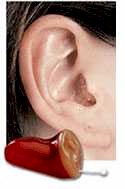
This is the smallest, least visible custom prescription hearing aid, much like contact lenses for the eyes. These amazing prescription hearing aids can be made with enough power and clarity for a wide range of hearing losses.
|
|
 |
|
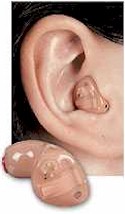
This is a small and cosmetically appealing custom prescription hearing aid. The slightly larger shell allows for more power to benefit a wider range of hearing losses.
|
 |
|
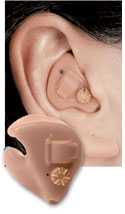
This custom prescription hearing aid fits securely in the ear. The larger shell allows for enough power to help even severe hearing losses without the need to wear anything behind your ears.
|
|
 |
|
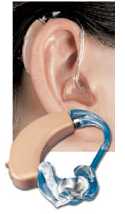
This prescription hearing aid rests behind the ear and is connected to a custom-made earmold. It is the perfect choice for people with severe to profound hearing losses.
|
 |
|
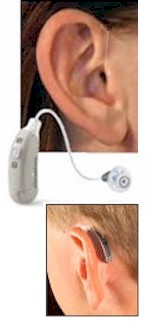
This hearing aid rests behind the ear and is connected to a "mushroom dome" which inserts into the ear canal. It has been overmarketed by the industry by "how invisible this hearing aid is", but as you can see from looking at another angle in reality it is not that invisible. It may be fine for some people, but is much overused by many hearing care providers as a short-cut even when it would not be advisable for a particular hearing loss. Be weary of any provider who automatically presents this type of hearing aid without giving you any other custom options, as most prescriptions that can be made using this style can also be created using any or most of the above custom styles as well.
|
With advanced technology, state-of-the-art microcircuitry, and sophisticated prduction techniques, your custom-made prescription hearing instruments will deliver outstanding sound and enhanced clarity, and will enable you to comfortably enjoy the world around you once again.
"Use of hearing aids is perhaps the most important factor in rehabilitating
people with nerve hearing disorders," writes Dr. Gale Gardner, M.D., world-renowned ear specialist and author of Nerve Deafness and You. "Hearing
aids won't cure nerve deafness any more than glasses will cure poor eyesight.
Hearing aids can, however, help most people with sensorineural hearing
impairment - nerve deafness -- to hear better, an important first step
in reestablishing an individual's social, economic, and emotional well
being."
© 2024
Herkimer Hearing Aid Center
|